
The Scientific Method
At the heart of all science fair projects is The Scientific Method, which teaches students how to gather information about a subject, come up with a question based on what they know, predict the answer to that question, define a method to test their prediction, test or measure it, analyze the data they collected, and draw a conclusion if their prediction was correct or incorrect. This method of observation and analysis is something we do every day. For instance, I know that (based on experience and observation) my food stays fresher in the refrigerator if I put it in an airtight container. But is this really true? Or is it just my perception. If I used the scientific method to analyze, test & collect real data, I could find out, for certain, if my observations were true.
.
The Scientific Method - Basic Steps
- Gather information and resources about your subject (observe)
- Ask a question
- Form a hypothesis (prediction) about your question
- Plan a method to test. Make sure your plan is reproducible.
- Test. Record your observations or test results in a table, chart or graph
- Analyze the recorded data - was your hypothesis true?
- Draw conclusions - what went wrong? what went right? Would you change anything in your experiment process to get better or more consistent results?
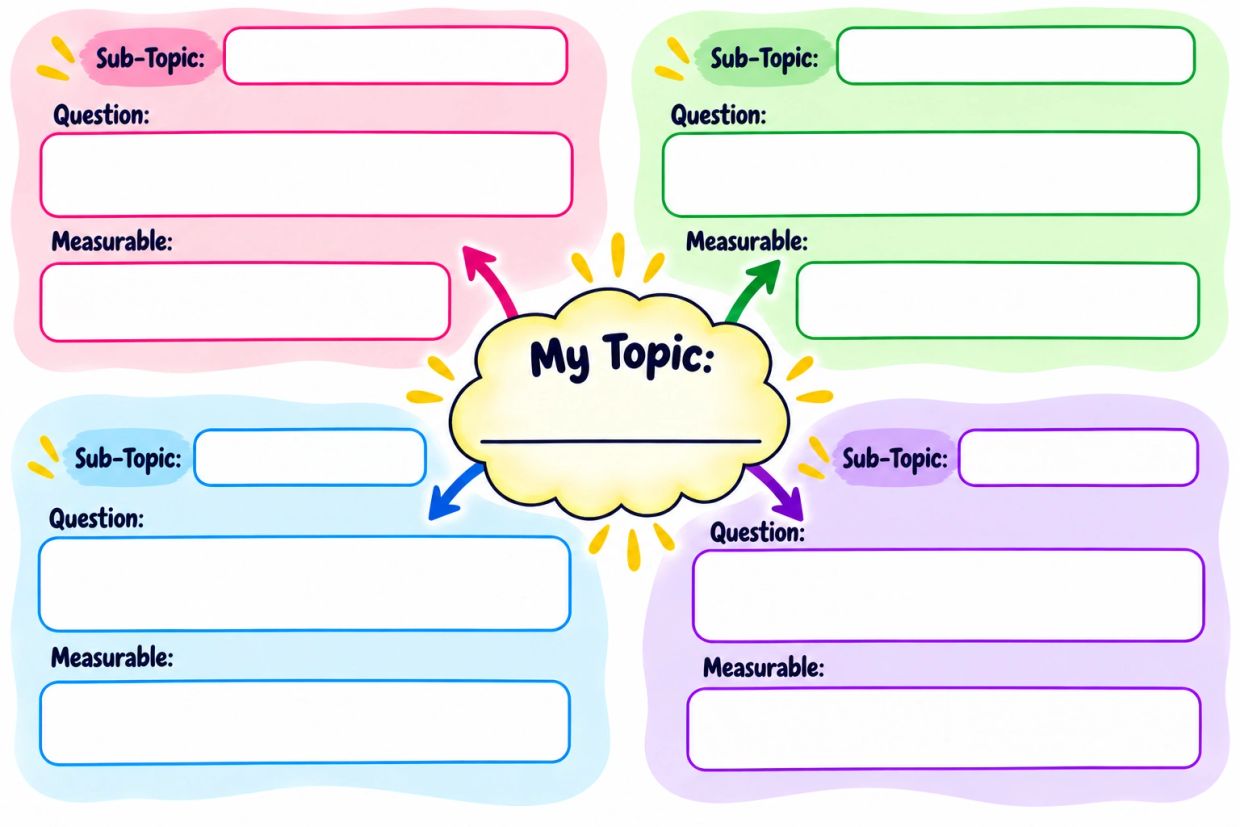
We encourage students to develop their own experiments based on their interests. For instance, if a student is interested in butterflies, brainstorm what they know, what they would like to know more about, what is measurable, and what is a feasible experiment based on the resources the student has. For each main topic, students might find 5-10 subtopics, but only design their experiment around one subtopic and one questions.
Topic: Butterflies
- Habitat
- Pollination
- Wing Size
- Host Plants
Subtopics & Measurable Questions
Habitat
- Where do butterflies live?
- Which habitats have the most butterflies?
What is a measurable question?
Count the number of butterfly species found in various habitats.
Pollination
- How do butterflies help pollinate flowers?
- How many times does a butterfly land on a flower before moving to a different area?
What is measurable that will tell us something about pollination?
Measure how the amount of time a butterfly stays at a flower before going to the next flower?
Wing Size
- Does wing size affect distance the butterfly can fly before taking a break and landing?
What is measurable that will tell us something about flight?
Measure the distance of flight between flowers before a butterfly lands
Host Plants
- Which plants do butterflies prefer for food?
What is measurable that might tell us what type of food the butterfly prefers?
Measure how many visits to different species of plants a butterfly makes
Need More Project Ideas?
Although we encourage students to come up with projects based on their personal interests, if ideas are needed, this website may help.
Resources for students, teachers, and parents

View Winning Projects
Get to the next level by learning from winning ISEF projects
How to Write an Abstract
Prepare your project's abstract with winning elements

Science News Learning
"At Science News Learning we are dedicated to expanding student science literacy across the USA by supporting a community of nearly 6,000 middle and high schools and more than 17,000 educators with equitable access to Science News Media Group's award-winning print and online journalism, an expansive library of ready to use lesson plans, each designed to incorporate recent applications of STEM research into core curricula, and STEM literacy professional development opportunities." The program is fully funded by Regeneron and other generous sponsors.